
FSU Retrospective: Daniel Arenas (FSU Ph.D. 2025) on Life after Bellamy
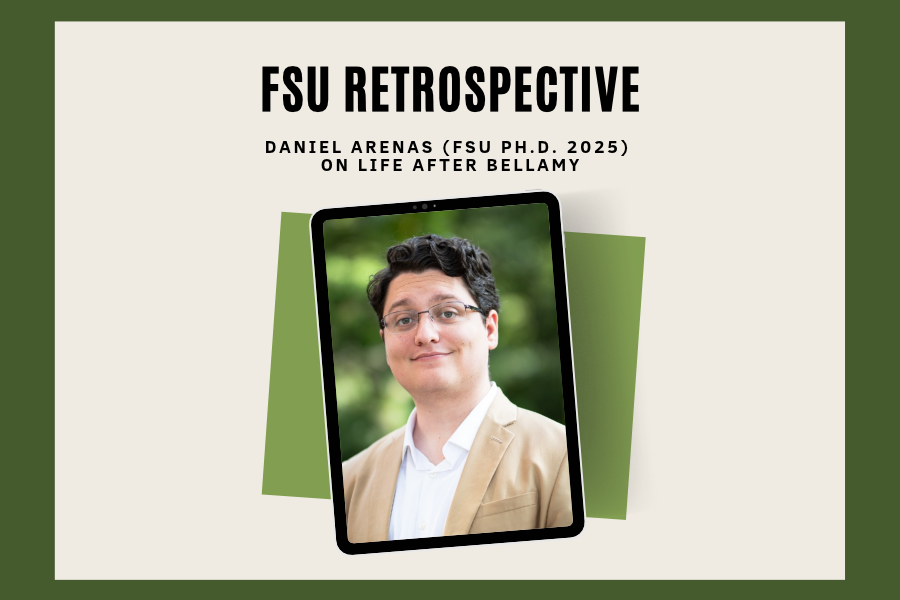
I graduated with my dissertation in Spring of 2025, and only now as I get ready to start my second year at Elmhurst University have I really had the opportunity to sit down and make sense of how drastically and quickly my life has changed since my time at FSU. I am grateful that our department goes to such lengths to prepare our students for the job search because, to be frank, that is quite possibly one of the most stressful aspects of the post-grad shift. Scouring job postings and following up on recommendations and leads from colleagues for positions that might not be posted yet led to a period of about nine months of nearly constant adjustments to my application materials and sending them out to nearly 70 different search committees. My experience observing the job search process here in our own department was absolutely essential; no two positions are the same and each demands a different approach to presenting how your specific expertise would fill their broader departmental needs. All of this while in the last stages of writing and defending a dissertation, no less…
I do not know what I did to deserve my luck, but I found a perfect match with Elmhurst. As I mentioned, no two positions are alike, and I always considered teaching to be a central pillar of my academic career, and this type of liberal arts college with small classroom maximums is exactly where I hoped I might work some day. But acceptance was only the first step, and things moved quickly. My position as Lecturer on Latin-American and World history has proved challenging and rewarding in the best possible ways. It’s a bit of an odd shift, from the hyper-specificity of grad school to the realities of operating within the needs of a department serving an entire student body, where instructors can and must be expected to teach a wide variety of topics. On top of the other personal and professional changes of jumping into the deep end, as it were, something I did not expect was how much the act of teaching would make me a better historian.
My specialization is on the Napoleonic wars in Spain and the Hispanic world, and the Atlantic world in the Revolutionary era more broadly. But immediately developing and teaching surveys on Latin American, African, and Asian history (only possible thanks to the depth of expertise of my professors in expanding my focus outside of my specialization) forced me to quickly and concisely explore the longer history of the foundational themes that lie at the heart of my historical expertise: the origins of modern imperialism and state political power outside of “the West.” Teaching these surveys has only underlined to me not only how important these topics are, but how much these other histories are affected by the same processes I explore across the globe.
More than anything, this has been a whirlwind of a year that, while rightfully demanding and not a little frightening in packing up my life and moving halfway across the country, has been uniquely rewarding. My fellow colleagues here at Elmhurst have been nothing short of saints in helping me adjust to the shift to professional academia, and I am proud to call them friends. Their guidance and mentorship has underlined what I think was the most important lesson FSU taught me: no one is an island. I only survived the application and dissertation process due to the support of my friends and colleagues, and I urge you to keep tabs on your fellows. A kind word or gesture often means the world, and it is our friendships that inspire us to be better historians, instructors, and people. I remain forever deeply grateful to the people of FSU for making me into the professional that I am in incalculable ways.