
What’s it like to be a teacher? An interview with Noah Cole, Ph.D. candidate in History
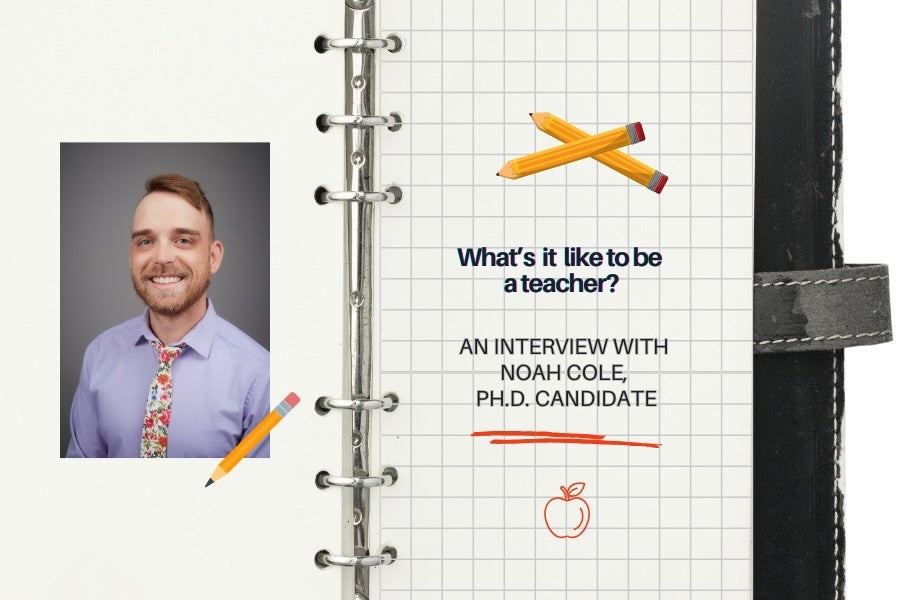
I came to FSU as an undergrad wanting to be a high school history teacher, and I got into my Ph.D. dissertation topic by accident. I signed up for a class on medieval Italy, and I got drawn to the history of the Middle Ages. I study 15th-century Italy, in particular preaching and political theory. I am now in the 5th year of my Ph.D. and am hoping to defend my dissertation in 2027.
How does it feel to teach?
I love teaching. To me teaching is providing people with a way to explore themselves through different topics and skills. I feel very grateful that I get to teach; I had a lot of teachers who helped me figure out what was important to me and what not, what I believed and what I did not believe. A big part of learning is realizing that you have been taught certain things, but as you get older you do not believe those things anymore, your values shift. Teaching should create a safe space for exploring those things. For figuring out who you want to be as a person.
History in particular is a very effective discipline for doing that. History demands that you confront bigger questions about human existence. It also demands that you address the question of why we are the way we are right now. History makes you ask questions like: “Who are we?” – “Do I want to be part of that?” And, “where is this all headed and is this right?” Those searching questions are part of the historical discipline. That is why History is the perfect blend of philosophy and practicality. In History, we do story telling about the human condition rooted in events that actually happened, or that people at the time thought had happened. This protects it from becoming purely speculative, but you can still explore the big questions in different contexts.
Teaching history means having the expertise to pick exemplary tales from the past in which people of the past were confronted with a set of problems that we still wrestle with today. I find it valuable and enjoyable to facilitate that look back to understand the present.
What is your goal as a teacher?
I want people to develop critical positions on what they want to do with their life. That is the number one thing I am concerned with. Secondarily, good teaching of history can help you fix problems in your own life. You have the playbook of the past, that helps you contrast your reality with the past. History is a safe space to explore contemporary problems. You can ask questions about situations in the past that might be a bit risky to ask about in the present, whether that be about culture, politics, gender, and so on. In a history class, you can take time to interrogate such issues until you have come up with an answer that satisfies you.
For me, for example, my own research on partisanship in the Middle Ages allows me to discuss partisanship in a (for us) remote time and location in a way that I cannot do with contemporary versions of partisanship across the world. In fifteenth-century northern Italy, people were asking questions like: “What is freedom? How do we justly organize the state? Is oppression part of freedom? Can one be free in a society that has so much coercion?” What is different is the historical context in which the people asked these questions. The questions are very relevant to us today, and the answers that medieval Italians came up with invite comparison.
What I am trying to do with my teaching is provide an avenue for people to explore tough and difficult questions so that they can come up with answers that satisfy them.
How do you know a class was a success?
Participation and discussion are a good sign that a class is successful. Students accepting changes to the class structure is also an important indication. For example, asking the handful of students who are always participating to hold back for a little while and other students then stepping into that space and talking is a good thing. I have given out anonymous surveys in which students comment that they appreciate the opportunity to speak. Another sign is when I ask students to do more complex tasks, and the students follow along and do it – that is a good indication of success too.
Seeing students putting effort into assignments that are graded for completion shows me that they care – and that means that the class is a success. Similarly, when I see students improving in their written work and incorporating my feedback into their essays, that shows me, on the assessment side, that students are invested in the class.
Another thing is the moment when you see students becoming friends with each other. I try to foster that as much as possible. I have students do partner work all the time. But even as late as week six, I might ask them to reintroduce themselves to their partners, as that is something that students forget easily. So, hearing students call each other by name is a huge step. Class discussions are only going to be as good if the students feel comfortable in the room and feel that it is an environment in which they can take risks – and that it will be understood by others that they are taking a risk. So successful collaboration is another mark of success.
Finally, attendance matters too. Having a class in which students attend consistently is a good sign of success. Of course, attendance only goes so far as a marker as there are moments in the semester when it is very difficult to get the students into the room.
What have you learned from your students?
A lot. They constantly push me, often unintentionally, on why things happened the way they did. As a historian I am often satisfied with the causal explanation I have provided to the class, as I have read a lot of material on the topic of the day. But then someone raises their hand or writes in their essay: “Why? Why did this cause that?” That’s when I have to take a step back and approach the topic from another angle.
For example, in the class on American history to 1877, one of the topics we discuss is that many Americans were not that patriotic after the war of independence. There were people in the West who took oaths to the king of Spain and gave up their American citizenship for land. We also have a large group who for a variety of reasons join Native nations and refuse to rejoin white society. For historians, these decisions are explainable, we have terms that indicate the hybridity of the frontier world, the experimentation that was going on there. Every time I teach this class, I get students asking: “But why? They just fought this huge war? Why did their war-time patriotism not transfer to the period afterwards?” These questions push me to reexamine accepted wisdom and to think through history again.
I have also learned a lot about concise writing from my students. Undergraduates are very punchy with their writing in ways that I am not. As a medieval intellectual historian, I write with (often too much) complexity and when I read our undergrad’s writing, because of their more limited knowledge base, many possess a sureness about their arguments that I find inspiring. They write “This is why it happened.” I can see how the evidence at their disposal allows them to come to conclusions with great certitude. A big part of my job is to get them to nuance these statements. But from a clarity of writing perspective, I can learn something from the students.
What has teaching taught you about yourself?
Again, a lot. I am a better lecturer than I thought I would be, but I am worse at course design than I thought I would be. I am happy with my ability to hold attention and command a room and tell a story. But I am trying to get better at scaffolding. Do my small low-stakes assignments build up the students to the bigger ones? I find that aspect of putting a course together much more challenging than I had thought it was going to be.
I find the big philosophical questions of history compelling; the students, although they find the questions compelling too, have a harder time wrestling with them as they are very broad. I have realized that I need to turn the big questions into more digestible units and tie them explicitly to specific historical events or persons. I like questions like “What is freedom?” or “What was Britishness in the runup to the war of independence?” But those were harder for students to answer as they did not have enough data to make compelling arguments. I have now gone on to link these broad prompts to specific primary source materials to allow students to grapple with something very detailed so that they can answer the broad question successfully.
I learned that what inspires me does not necessarily inspire the students. I also learned that what is easy for me to digest is not necessarily easy for the students.
The other thing to know is that I teach music and have done so for a while. It turned out that, for me, to build a lesson plan to teach music is easier than to put one together for history. In a music lesson, the students are doing something all the time, and you, as the instructor, are reacting and responding to what they are doing. It is almost a constant state of improv.
In history, there is a lot more emphasis on the teacher having to distill information to the student. And the students are often passive in that process. Clearly, the best teaching is when they are not passive, but lecture is lecture and is a part of the teaching process. Following my experiences with teaching music, I am trying to put more of an emphasis on the students to be doers and not just recipients of knowledge. I have a lot of ‘doing’ assignments for the students, analyzing, talking, debating, and I would like to shift my classroom even more in that direction.
Was there a particular undergraduate teacher who inspired you – how and why?
Yes, certainly, Dr. James Palmer. Part of it was that the subject he worked on really grabbed me, but I also admired his command of information. I had encountered excellent teachers before, but taking an upper-division course with someone who is an expert in the topic was a different thing. I was awed by how much he knew. At the time, my goal had been to become a high school history teacher, but very quickly I realized that I wanted to have that kind of mastery of the material. It made me realize that I needed to keep learning.
Dr. Palmer’s command of information and the excitement he had about it were both infectious. Before I took his class on medieval Italy, I thought the Middle Ages were lame. I did not know anything about them, I just had the stereotypes of knights in shining armor, ladies and peasants. And then when I took his class, we talked about the decline and fall of Rome, the migrations of the early Germanic peoples, the kingdom of Italy, the Carolingians, all those things. It was amazing.
The other teachers who inspired me were my Latin instructors. I was really impressed by the amount of knowledge they had about Latin and the intensity and exactitude they brought to its study. Learning Latin felt in many ways like studying music had been in terms of the instructors. The work had to be correct; there was an intense expectation for excellence. I had not liked it initially in music, but once I had got used to it, I found it addictive to be really good at something. And to be made to be good at something, I valued that. There were no excuses. The instructors were unrelenting. Latin teachers were very similar.
The History department in general I found to be full of pleasant people who were trying hard to understand big questions, and it made me feel like I belonged. Dr. Doel sticks out because of his storytelling passion in the classroom; it was not just names and dates. It was the story of humanity, of who we are and what you want to do with your life. Thinking about that began for me in his classes. Dr. Doel teaches more modern topics, and his classes caused me to ask questions about modern issues. It was a perfect mix with my medieval focus.
Final thoughts?
The basic question I think about is how to view the students as learners. A lot of my thinking comes from the work of Paulo Freire and his book Pedagogy of the Oppressed (1968). The book revolutionized how I thought about teaching. It taught me to consider everybody in the room as an expert in something. They will not be an expert in your subject matter, but they are not an empty vessel that you need to fill. Their frameworks for knowing things need to become a part of your classroom. A lot of Freire’s ideas were influential in shaping student-centered learning. I see my students as contributing to how I see the past, and we are part of a learning process together. I am guiding that process because I have a particular area of expertise which means I spend more time thinking about it.
Great teaching gets everybody to contribute to the learning experience in the classroom, to the soup of knowledge that we are stirring, that is how you build trust in the classroom, how you get student investment, how you get them to keep showing up. When students feel that they are developing their own frameworks of knowledge that is when you can help them develop critical opinions about the world which will shape them for the rest of their lives.
Good teaching teaches information. Great teaching teaches process. Excellent teaching has the student develop both of those at the same time. Them developing their own process of thinking and critiquing it, seeing it in others, that’s the goal.