
History-Intensive Semester in London PLUS Senior Seminar: An Interview with Ciara Watson (FSU 2026)
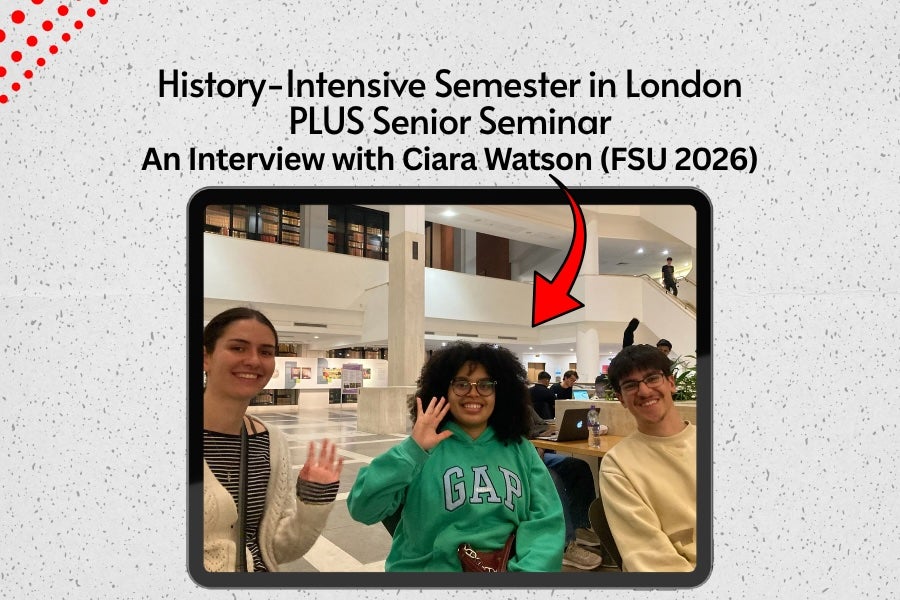
History has always drawn me because of its story-telling side. History and culture are closely connected, and I want to learn more about the world, especially things I have not heard about before. I am from Orlando, and I decided to go to a different place for college. Tallahassee as the state capital seemed a great location. I want to pursue a legal career, and I thought that Tallahassee would be a great place to find legal and government internships.
How did you combine studying abroad with the senior seminar?
I had not thought about studying abroad until I spoke with Ms. Kozar, History’s academic advisor. She told me about the History-Intensive Semester in London that Professor Upchurch had organized for fall 2025. And I thought that would be a great opportunity. I had not traveled to Europe before, so England was a great choice as I would not encounter language barriers.
I took the two History classes that Professor Upchurch was offering in London, the ‘History of England since 1870,’ and ‘England, Empire, and Commonwealth.’ He ran both classes the same way: he lectured on a topic for the first part of the class, and then we went outside and saw in person what he had talked about. The material became real when we went outside. London is such an old city, we could immerse ourselves in its history, different types of history. It was so engaging and fun to see the classroom come to life this way. I particularly enjoyed going to the Victoria & Albert and the Natural History Museums in Kensington. Even after our classes had ended, I stayed on longer and continued looking around, to see more of their exhibits. There was so much to take in. That is also how I found my senior seminar topic, through one of the excursions we did. It was tied to the British Empire and Commonwealth class.
We went on an excursion to the National Portrait Gallery, and we looked at all those pictures having to do with British history. In one room, I saw the portrait of a Shakespearean actor, Ira Aldridge (1807-1867) – he was the only Black person in the room. Seeing his portrait I wondered, who is this person? Why is his portrait on display in this room? And seeing his painting made me also start my own research to understand who he was. Then I discovered that he was American-born, and my interest just grew from there. Dr. Upchurch mentioned the senior seminar in spring 2026, and how my research in London could tie into that.
What was the specific question you wrote your senior seminar paper on?
Initially, I wanted to find out how audiences responded to Aldridge’s acting at the time. Later, I expanded that to included how he used his theatrical performance for political ends both within the British and the American contexts. Aldridge was the first Black actor to play Othello, and from there he moved onto other Shakespearian plays like Macbeth and King Lear. He brought a more human dimension to Othello, which was a new perspective. It was not something that was immediately appreciated by the audiences at the time.
My main primary source was newspapers from the time which included opinion pieces and reviews of the plays Aldridge was in. I also found some correspondence that reviewed his performance, for example, letters by the writer George Eliot (1819-1880). Eliot wrote about disliking Aldridge’s style of acting. I got most of my material from the British Library, especially its newspaper room. I spent a lot of time there going through different issues, looking at advertisements and how Aldridge was described. It was interesting learning the etiquette of archives and libraries and the technologies used to consult material.
We went to a series of archives with Professor Upchurch during the semester abroad. Besides the British Library, we went to the UK National Archives in Kew. Those who were interested also saw the V&A archives, and the National History Museum archives. Basically, every museum we visited had an archive attached to it We also attended an event called ‘History Day,’ which was a fair of all the archives in the city. Going from table to table, we talked to the archivists to see what material they held. That was when I discovered that the Globe Theater, which is a reconstruction of the original theater Shakespeare’s plays were performed in, had an archive too. I was able to find some good secondary sources in the Globe.
How did your topic change when you started the senior seminar?
By the end of my London semester, I had a draft of what I thought I was going to be working with in the senior seminar. But during the spring senior seminar class, I decided to make my research more complex, and I broadened the topic to include the politicalness of his acting. I had to find more secondary sources to include that analysis in my paper. Most of the spring semester was devoted to developing my arguments more fully to bring something new to the discussion of Aldridge’s career.
I used my draft from the fall semester as a frame. Every week, we would outline and analyze articles, which influenced the way I wrote the paper. I ended up with something completely different from what I had set out to write. I prefer this version over what I had thought I was going to do. It is more interesting and more complex.
Doing the in-class presentation was especially helpful for formulating my arguments. It provided me with insights into how my peers understood my paper. Based on their questions, I saw how they perceived my ideas, and I could make corrections before the final paper was due. It was an amazing experience, finally being able to present my ideas that I had been working on for so long!
What was the most surprising thing you found during your research?
I would say my initial assessment of Aldridge’s impact. Since I saw his painting in the National Portrait Gallery, I thought that this man must be very loved and popular. People will have amazing opinions of him. But when I did my research, I realized that there were quite a few people who did not like his acting when he started out. But then over time, people’s perceptions of him changed and he came to be respected in his later career. It was fun to chart this change and see the change in opinion unfold in front of me.
The greatest challenge was finding primary sources for my project. Initially, I had hoped to find things written by Aldridge himself to illustrate his experience. But I could not find anything. Then, I met with Professor Upchurch and told him of my struggle: Where am I taking my primary sources from? And he suggested that I look at newspapers to get at the popular opinions of the British public. That was when I started using the newspapers in the British Library. The BL’s reading room was easy to use. I had not thought about using newspapers before.
What is your advice to History majors about the senior seminar?
My advice is: think outside the box. Your research can branch out from anything that the class is about, anything that you are curious about – even if it seems an insignificant detail. Use the senior seminar to explore a topic that you are interested in, as this is your opportunity to explore something on your own.
My advice to myself is: go with the flow and stress less about deadlines. Be in the moment. And it is OK if things are not going the way you expected them to, use that as an opportunity to review what you are doing and sculpt your argument in a different way.
Would you have done your project if you had not been to London last fall?
I think that I could have done a project, but I would not necessarily have come up with this topic. If I had not gone to the National Portrait Gallery and seen that painting for myself, I would never have found Ira Aldridge. I surprised myself when I decided to work on Shakespearian theater. I thought that I might work on something to do with the British government or politics. But being in London and seeing things firsthand helped me expand my curiosity.
How important was the History-Intensive Semester abroad to you as a History major?
It is a fantastic opportunity for History majors. It is all good to hear the lecture and read the textbooks, but when you get to see your sources firsthand, you learn the material better. It is so engaging, and it made me feel more connected to history in a way that I had not felt in previous semesters. It is so exciting to see your topic come alive. I wanted to do more and more and more history. Being in London was a great opportunity to immerse yourself in a culture that is kind of similar, but also drastically different from your own. And then you get to engage with your classroom in the real world, you see everything firsthand and hands on. I would definitely do it again!