
#SeniorSeminar Interview: Jane Cohen & “General Issue Fun”
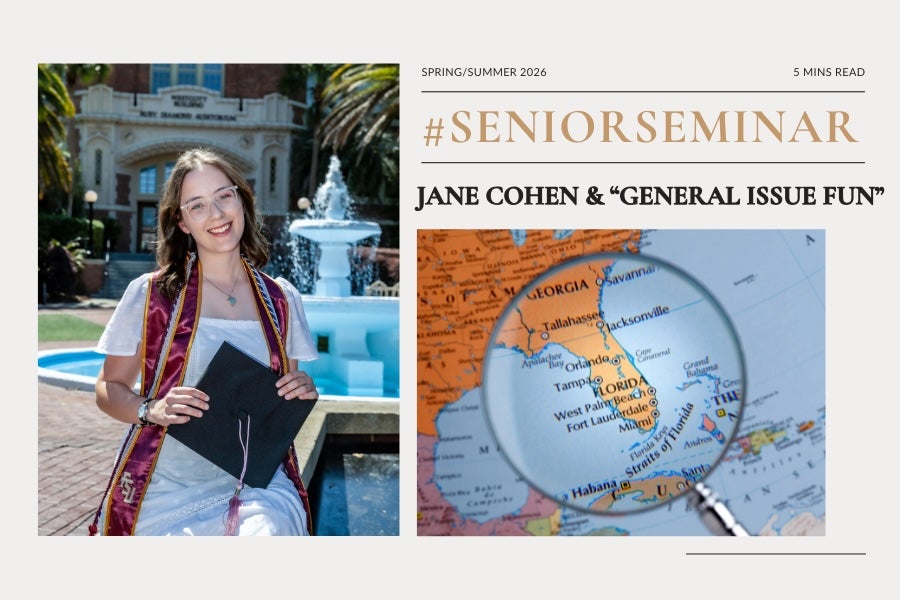
My primary major coming into FSU was music. I play the trombone and came to FSU for the College of Music. I am from Tallahassee, and my mom works for the FSU Music library, so I was exposed to the FSU community growing up.
I liked history classes well enough in middle and high school, but never really thought it was that big a thing. However, as a kid, I started exploring primary sources on my own without really realizing it. I remember my aunt had an old issue of Time magazine that I looked through, and I was obsessed with all the old ads. When I was at Leon High School, I discovered that FSU had a full archive of their yearbooks and newspapers going back to 1920. I enjoyed just sitting there and reading these documents created by students like me — and that had not been written to be read a century later. They were full of inside jokes, and class prophecies of what people would become. I started looking the people up to find their obituaries which told me what they had done with their lives.
When I came to college, I was interested in a second major, and I decided to look at the program of study for History. I saw that I had gotten AP credit for three out of the four survey classes required and thought, 'Well, why don't I take the fourth one, to see if I like it.' And I really did like it. Separately, in my freshman year in one of my music history classes, I wrote a project on the history of the banjo, specifically its short-lived rise as an instrument for upper-class society in the late 19th century. I found all these banjo-specific magazines from the time which were fascinating. That was my first time using primary sources to actually support my argument in an essay instead just adding a picture because I needed it to meet the project requirement. Over the course of my freshman year, I fell in love with primary sources.
I am interested in the turn of the 20th century in the United States, especially popular culture. That is not a time when many famous events were happening but still a lot of things changed due to industrialization. The period sees the first form of mass national entertainment. Plus, the outfits looked cool.
What did you write about in your senior seminar paper?
I took Dr. Piehler’s senior seminar on the American GI in World War II. I called my project ‘General Issue Fun,’ and I focused on soldier recreation in training camps in north Florida: Dale Mabry Field in Leon County, Camp Gordon Johnston in Franklin County, and Camp Blanding in Clay County. My argument is that the U.S. Army had widespread programs to provide recreational opportunities that helped build morale for soldiers. The Army recognized that this was something important, but these opportunities were not available equally, and not everyone wanted to participate.
What records did you use to support your claims?
My main sources, which were also what got me into this topic, were soldier newspapers. During World War II, there were over 4,000 of these individual titles published around the world by U.S. soldiers both domestically and abroad. The newspapers were published by individual camps or military units, and they read like the student newspapers I looked through in high school. They were full of gossip columns, and entertainment announcements about movies, sports leagues, and so on. I found the contrast between what you expect a military newspaper to be and the actual tone of these papers so very interesting.
These newspapers were officially approved publications. There had been memoranda from military higher ups to set up camp newspapers. Every paper had to pass the censors and the public relations officers at the base. Sometimes, if the unit was stationed abroad and the paper was produced overseas the soldiers had a little bit more leeway in what they wrote about because of the remoteness of their location. Despite the censorship, the newspapers provided quite a transparent slice of life. It was not a platform that allowed soldiers to debate the war as a whole, but they could complain about the food or the lack of transport to nearby towns.
Another major primary source I used were official Army guides and handbooks. I found one from the Special Services Division which ran a lot of the sports and music programs as well as the newspapers. They had a specific army editor’s guide on printing your camp newspaper. At the Camp Gordon Johnston Museum in Carrabelle, I was given training schedules from 1943, and they showed how much soldiers had going on in a given day and how limited their time was for non-military things.
What surprised you about your research?
I think the biggest thing was the amount and breadth of events happening in the training camps that were written up in the newspapers. There were a lot of variety shows that involved random items: someone knows how to tap dance, someone will sing a song, and another person can do some magic tricks. And in the next article, the story will talk about a battalion’s pet alligator. A lot of quirky things like that.
I also discovered that the army published musicals with complete scripts to be performed by the armed forces. Most of these were meant for overseas use (so they did not make it into my paper), especially for areas where it was not safe for civilian entertainers to go. These musicals were meant to be unifying events, but that unity often came at the expense of someone. They have roles soldiers in drag, but and also in blackface, with the official Army makeup kit containing black face makeup and wigs.
What were the greatest challenges you encountered in doing your research project?
For historians, it is always exciting to have a lot of primary sources available. However, especially for a project like this, I would have liked more secondary sources. It was not easy to piece together the histories of the different bases in the region. I found some stuff for context but no detailed histories. Additionally, there was one main army branch that dealt with entertainments, the Special Services Division, but I had a hard time finding anything on them. I found a guide to their activities overseas, but that was not my topic. My work was perhaps a bit more groundbreaking than I had planned it to be. Instead of hunting for primary sources, I found myself hunting for secondary material.
This was not the first major paper I had to write. I had already completed Honors in the Major in Music, my other major, and compared to writing an honors thesis, the senior seminar is a much smaller project. One challenge for the seminar paper was just finding the time for the actual paper as we had to do weekly readings as well for our class meetings. I am the person who spends most of their available time doing research, then I have to put the paper together in a short time. Clearly, that is not the best way of doing things. Doing the Honors in the Major first taught me much about the process of research and writing, and I learned a lot from that experience, but I still need to work on getting done with the research faster, so I can figure out my argument and start writing sooner.
Was doing a presentation to your class helpful in thinking about your paper?
It forced me to summarize all the things I learned into something cohesive. We were only given five minutes to speak, so I had to think through the most important points that I wanted to make to tell the story. Otherwise, I would’ve been sharing random fun facts, which is not what the class presentations were there for.
What advice would you give to History majors who are thinking of taking the senior seminar?
My big advice: explore what your potential sources are before committing to a topic. Check out the archival collections to know if there is material for you to work with. In my case, I work for the State Library as a library clerk, and last summer we were digitizing some microfilm which included about 30 reels of these soldiers’ newspapers. I was looking at them and thinking, “these are fantastic, someone should do a project on them.” And when I saw they were offering a World War II senior seminar, specifically from the American GI perspective, I realized that that someone would be me.
If you could start again, would you have done anything differently this semester?
I think what I struggled with the most was pacing myself. Throughout the semester, we needed to submit a topic proposal, then a bibliography, after that a first draft and then the final draft. We also had to write a book review on a book related to our project. Despite these deadlines, it was tempting to think that the final product was not due for almost three months. It would have been better for my sanity, and I might have produced a more well-rounded paper, if I had set aside some time every week to work on the project. The senior seminar is all about learning how to write a longer paper.
What is coming next?
I will take a year off and then apply to graduate school. I am not quite sure in what, something to do with history or musicology or American studies. Having lived in Tallahassee for the last 22 years, I would like to move to another place, another university to experience new things and work with new faculty.