
What Is It Like to Teach English in Hungary? An Interview with FSU History Alumnus Kieran Stenson
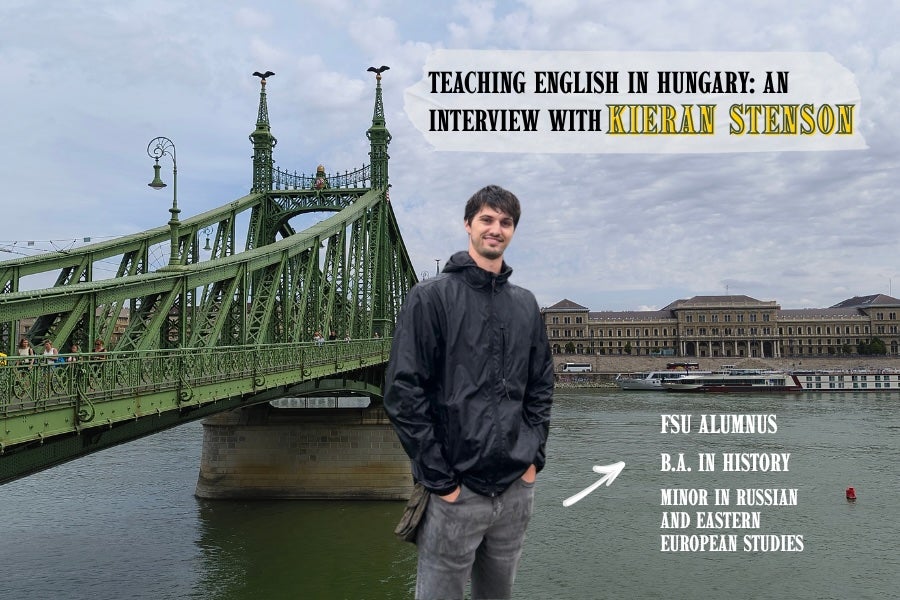
Florida State University history alumnus Kieran Stenson spent the fall of 2025 teaching English to elementary school students in Budapest, Hungary. In this interview, Stenson shares his experiences teaching abroad, reflecting on the challenges, cultural differences, and lessons he learned while working with Hungarian students.
Stenson graduated from Florida State University in December 2024 with a bachelor’s degree in History and a minor in Russian and Eastern European studies. During his senior year, Stenson spent a semester learning Polish at Jagellonian University in Poland. This time abroad in Central Europe deepened his interest in cultural exchange and ultimately influenced his decision to pursue opportunities outside the United States following graduation. As a History major, he felt well prepared for spending time abroad. “History makes you willing to learn about other ways that people live.”
During his time at FSU, he took the History Online internship course. During the internship, Stenson worked with graphic design platforms and social media tools to produce content for FSU’s Department of History website. Although he had not previously considered himself particularly interested in digital media, the experience expanded his understanding of how historical scholarship can reach broader audiences. Stenson explained that “the internship helped me see how historians go beyond academic writing through social media and digital content.”
Soon after completing his undergraduate degree, Stenson relocated to Budapest for a job opportunity as an English-As-A-Foreign-Language teacher at a Hungarian elementary school. Living in the Óbuda district, an area built around the remains of the Roman settlement Aquincum, he encountered history not only as a subject of study but as a visible part of daily life. His commute to school included passing preserved ruins of Roman baths and aqueducts, an environment that reinforced the close connection between historical study and lived experience. “You are going down the road on the bus, there are ruins of the Roman aqueduct on one side, and ruins of Roman baths on the other. This was the border of the Roman empire.”
In the classroom, Stenson taught multiple lessons each day to young students learning English as a second language. “A typical day involved leading interactive lessons and helping students practice speaking English,” Stenson said. “Seeing them gain confidence over time was one of the most rewarding parts of teaching.” The role presented new challenges, including navigating cultural differences and teaching in an environment without a shared first language. Despite these obstacles, he found meaningful similarities between Hungarian and American students, more specifically in their familiarity with media and online culture. “Even though we didn’t share the same first language, the students were very familiar with global media and internet culture,” Stenson noted.
This teaching experience significantly reshaped Stenson’s perspective on education and professional development. His time working as an educator in Hungary strengthened his appreciation for the difficulties of teaching and the ways students learn.
More broadly, living abroad provided him with clarity about his long-term goals and professional interests. “When you travel, you get this feeling that there is so much of the world out there. There are so many things you could be doing, and you can't even do close to all of them. To try and experience what one country can offer would take a whole year at least. A lifetime maybe.”
Following his time overseas, Stenson began applying to graduate programs in public history and historic preservation, fields that blend research, cultural, and public engagement with the past. He credits his international experience with helping him better understand how historical knowledge can connect communities across geographic and cultural boundaries. Stenson will start a master’s program in Public History at FSU in Fall 2026.
Reflecting on his academic and professional journey, Stenson emphasizes the importance of pursuing new opportunities, even when outcomes are uncertain. He encourages students to explore experiences beyond their comfort zones, noting that experimentation often leads to unexpected growth. “My main piece of advice would be that there is very little downside in trying out something new. Because even if you aren't the biggest fan or it does not work out perfectly, you learn a lot.”
Through study, travel, teaching, and public history work, Stenson’s path illustrates how historical scholarship can extend beyond the classroom into lived experience. His journey demonstrates the evolving role of young historians as both researchers and communicators, engaging with the past while actively shaping the future.