
#SeniorSeminar Interview: Further Noumena (FSU 2027)
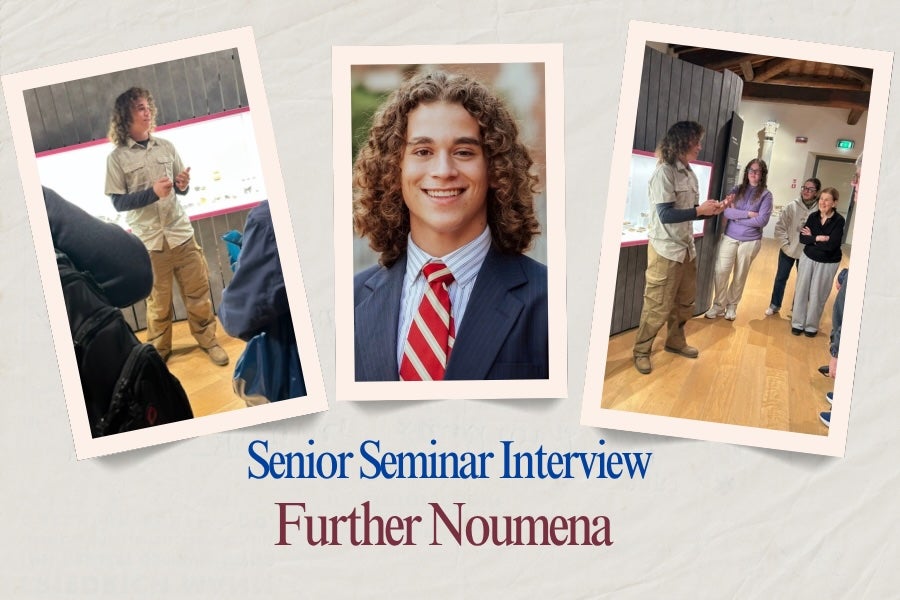
I have always loved history. Growing up my family travelled a lot. We camped in national parks and went to many museums. Ever since I was just a little boy, I have been reading history books, and I have been obsessed with fantasizing about the past. My dream since I was a kid was to be a historian or a museum curator or something in that realm.
Here at FSU, I focused on getting prepared for work in museums and public history. I am a History major with a museum studies minor. I have volunteered with Dr. Frank at the at the Native American Indigenous Studies Center. I came to FSU because it has a strong History department and the museum studies minor has been fantastic. I recently got to co-curate an exhibit in my museum object class in the William Johnston Building gallery called “The Weight of Exchange.” The exhibit showed metalwork from the Ashanti Gold Coast, modern day Ghana. We had a collection of 17 weights that they used to weigh gold dust in their trade. These gold weights were made of brass and very ornately decorated with birds, snakes, chameleons and symbols. I wrote labels for the exhibit, and it got me addicted to the curation process. I am excited to delve more into curation for my Honors in the Major project.
What topic did you work on for your senior seminar?
I took Dr. Herrera’s class on the history of Latin America and violence. My topic was on Cuban exiles in the 1960s and 70s, mainly in Miami and New Jersey. I looked specifically at militant Cuban exiles and how they used a rhetoric of betrayal to justify violence, whether it was violence against Cuba, violence against countries that were trading with Cuba, or violence within the exile community against people they deemed as enemies.
What sort of sources did you use for that?
I looked at a lot of sources made by the Cuban exiles themselves, such as radio transcripts of speeches given by prominent Cuban exile leaders. I reviewed newspapers published by Cuban exiles as well as political cartoons drawn by them. I also analyzed some books published by prominent Cuban exile leaders.
I made an appointment with the humanities research librarian – that is something I would recommend to anyone taking the senior seminar. She helped me find material. Dr. Herrera recommended great secondary sources that I would not have found any other way. But the greatest number of sources came from this website called Latinamericanstudies.org. It had PDFs of many different old newspapers and other relevant material. That site was incredible. I also worked with government documents from the CIA archives.
Most of the material was in English, but some was in Spanish as well. I know a little Spanish myself, but I utilized Google Translate, and I cited that in my bibliography. The sources that were aimed at members of the Cuban American community were in Spanish.
What made you want to work on this aspect of Latin American history?
My grandfather left Cuba in the early 1960s when he was a child because of the revolution. He did not live in either Miami or New Jersey nor was he a militant exile. But I was interested in that perspective because of the trauma that these events caused him. When I learned how violent the militant Cuban exiles had been in the 1960s and 70s, I wanted to find out why they did that, and how they justified it in their speeches. Ten years after the revolution – why were they still so focused on that?
I argue that they see the socialist government of Cuba as illegitimate. The rhetoric of betrayal allows them to continue being militant. The exiles see a continuous line of betrayal. The original betrayal is that of the revolution by Fidel Castro who turned it Marxist-Leninist. This justified their waging war against Cuba. After the failure of the Bay of Pigs invasion and the Cuban Missile Crisis, the United States betrayed them through the Kennedy-Khrushchev Agreement. This justified the militant elements waging a war on the U.S. And then they felt betrayed by those within the Cuban exile community who wanted to assimilate to American culture and focus more on immigrant issues. This allowed them to wage war against other members of the Cuban exile community who did not share their goals. This vision of betrayal is what shaped and explained their actions.
What surprised you when you did your research?
What surprised me the most was the infighting within the exile community. At any one time, there were many different militant organizations all doing the same thing, but doing it slightly differently. Prominent exiles belonged to multiple groups. If there were disagreements, they often resorted to violence. The infighting showed me both how disconnected, but also how interconnected the community was. Sometimes, militant organizations worked together, at other times they fought each other. The relations within the exile community were very deep.
What was one of your challenges that you had to deal with or that you overcame?
The biggest challenge for me was constructing the theoretical framework for the project. That is what sets the senior seminar apart from other classes. The paper needed to be a work of original history with a theoretical framework and a specific methodology. Initially, I did not know what framework to use for my primary sources. I had a meeting with Dr. Herrera in which I explained my problem. He helped me connect the sources through looking at the rhetoric of betrayal. That allowed me to periodize the events covered and to narrow my investigation. Dr. Herrera recommended a couple of books for me to read and that helped me craft a strong theoretical framework. My recommendation to others is to meet with your professor early in the semester to discuss your ideas because that will help you clarify your approach.
Did you work as a group when you met for your weekly class meeting?
Yes, we worked as a group, which I loved. We all worked on different topics, countries, time periods. But we were a tight knit group. In class, we would recommend sources to each other and comment on each other’s work. That really helped. We even met outside of class in the library to review each other's papers. We had an open culture where we could freely critique each other's papers without getting our feelings hurt. It showed when we did the presentations. Everybody in the class asked me great questions, and you could tell that they were all paying attention and provided good critiques, but also compliments. The class felt like a proper seminar.
How did you stay on top of all your work? How did you handle time management?
Time management was an issue, and I think that me and all my peers experienced that. The senior seminar essay is a heavier paper than most undergraduates are used to writing, and I definitely struggled a bit. I felt I was on track in the beginning, but if I had done more thinking, I would have realized that I needed to tighten my argument. I had written 40 pages, but the paper felt weak. It was not until I met with Dr. Herrera and talked the matter over that I was able to format my thesis into something clearer and stronger. I should have done this a lot earlier. There were some all-nighters when my peers and I worked together in the library. It was kind of fun and made some good memories.
What advice would you give to History majors who might be thinking about doing the senior seminar?
Pick the senior seminar section that you are most interested in. Within the class, pick the topic that you love. Do not be afraid to talk to your professor. They are probably the best resource for you. Also make a research librarian appointment early, even if you are still a bit unsure about your topic. And then when you are getting deeper into it, meet with them again.
If you could go back to the beginning of the semester, would you do anything different?
I think I would go to Dr. Herrera’s office hours more to get help with my writing. My historical writing skills were not developed enough. That is the main thing I would change. As far as my research went, I think I did a pretty good job.
Where do you see yourself in five years?
I want to go into museum careers, whether that is curatorial or education or administrative, anything in the museum. Right now, I like the curatorial aspect because of the project I just did. But I am also a very outgoing, public-facing guy, so I feel like I would really enjoy education. Ultimately, doing something in public history and museums and presenting history to the public, that is my absolute dream.