
UROP in History: Expanding the Cold War Through Propaganda
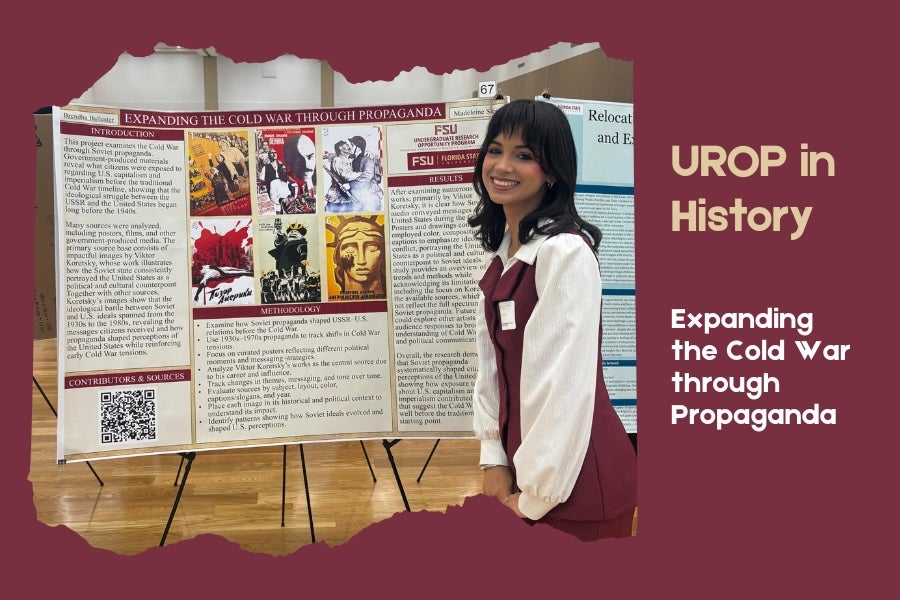
Madeleine Stout, Ph.D. candidate in History, directed a UROP project on the Cold War through Soviet propaganda. An aspect of the project was to analyze material from before the traditional Cold War timeline of the 1940s. The UROP project will feed into a journal article that Stout is writing on the Cold War through the lens of Soviet propaganda from the 1930s to the 1960s. Stout’s doctoral dissertation focuses on tracing the experiences of African American women in the Soviet Union and how it influenced their writing and activism back in the U.S.
This is the second time that Stout is directing a UROP project. She loved the idea of introducing students to history and mentoring them in primary research. She is working with one student, Brendha, who is majoring in political science with a minor in English. Brendha went to a law magnet school in which she took a range of law, history, and government classes. Brendha’s favorite historical period is the Cold War which led her to choose Madeleine’s UROP project.
How did you find out about UROP?
Brendha: After being admitted to FSU, I received an email from the Center for Undergraduate Research informing me of an informational zoom meeting about UROP. I thought, "Oh, this is cool." Because up to that point, I had thought that you could only do research if you were a graduate student. When I realized that I could start with research right away, in my first year, I thought, "Why not? This might be a fun experience, a way to meet people and make connections with professors." I attended the meeting, filled out the application, and was accepted. I applied to four different projects in the end.
I chose this project because I met Ms. Stout during the summer. She was one of the graduate assistants for the CARE history class I took. She mentioned that she had led a UROP project before and also what research she was doing, and I thought that this was a perfect opportunity.
What is your UROP project about?
The project is about propaganda, specifically Cold War propaganda, from the Soviet Union's perspective. The main argument is that the ideological struggle between the U.S. and the Soviet Union started well before the Cold War "officially" began. We reviewed posters, illustrations, and videos from the Soviet Union before the 1940s to document the kind of propaganda the Soviet Union was releasing against the U.S.
Initially, the challenge was to find propaganda material from the Soviet side. In reviewing online archives, I was often shown U.S. propaganda rather than Soviet documents. A big chunk of our sources came from books from the FSU libraries. Eventually, I put together a document with all the material that I found. I input the title, the date of publication, and where I had found it with a link to the website or archive. I also inserted a screenshot of the picture and wrote a short paragraph description on why I thought it tied into the project.
In the beginning, we sat down together and discussed some of the pictures together. Madeleine translated the texts from Russian, and we analyzed what the images depicted, the symbols used, the colors, and the language. It was not that difficult to interpret the pictures. Whenever I felt that I was stuck, I met with Madeleine during her office hours. At first, I tried to prove to myself that I did not need help. But then I hit a wall, and I found that meeting with Madeleine regularly helped me with the project.
What was the most interesting thing you found in your whole research?
I found all of it interesting, but to be honest, I did not know a lot about the Soviet Union aside from the very little that we were taught in high school. I had not realized the level of animosity toward the U.S. The Soviet material called out issues of racism, of lynchings, for example. Some of their pictures hit very hard, they were not trying to sugarcoat things. The target audience for their material was the citizens of the Soviet Union.
How did you handle time management?
It was scary at first. The UROP colloquium I was in met every other Tuesday. Often, they would give us about 30 minutes in class to work on the project on our own. But mostly what I did, because I was a CARE student and CARE required me to have study hours at the library, I would pick specific days and sit down in the library to work on the project. That was most effective for me. I did try working on it in the dorm a couple of times, but if I am being completely honest, I could not focus at all.
What was the most challenging thing about doing UROP as a freshman?
What was overwhelming was the first couple of weeks. The process of joining all those Zoom meetings to attend the different UROP information sessions on the projects I was interested in. There were so many options, so many possible projects to choose from. It was hard to find the time for the meetings as some were at the same time as I had class.
After that, the next difficult thing was to get started. Madeleine told me to reach out with any questions, but I did not want to reach out immediately. I did a bit of online research, and when I ran into stumbling blocks I did reach out. Once we got into the flow of our meetings, things went a lot more smoothly.
What advice would you give to students who are considering participating in UROP?
I say, Go for it! There are no cons in doing it. Yes, you will be busy because of it. It might also overwhelm you at times. But that can happen with anything you might do, university, classes, anything. It is a great opportunity and can help you gain valuable experiences.
Are you thinking of continuing with research while you're at FSU?
I am definitely thinking about it, especially since I have learned that FSU has a study abroad program in which you can do research abroad. I am hoping to spend a summer semester doing that.