
UROP in History - The Antietam Project: Examining the Civil War's Bloodiest Battle from a New Lens
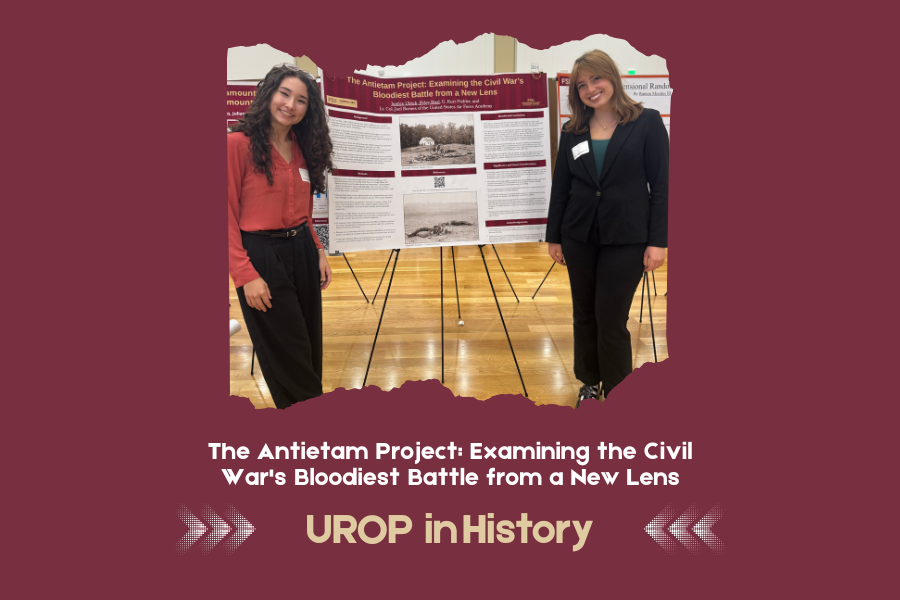
Professor Kurt Piehler spent the academic year 2024/2025 as a visiting professor at the United States Air Force Academy in Colorado Springs, Colorado. During his stay, he met Lt. Col. Joel Barnes, a fellow instructor, who shared his research on the Civil War battle at Antietam with him. Together they developed a UROP project investigating the discrepancies between visual and written evidence regarding the level of resources available to Confederate soldiers. The American Civil War was the first major conflict to be recorded in photographs.
Piehler is professor of history and director of the Institute on World War II and the Human Experience. His expertise is in religion and military history. He and Lt. Col. Barnes, an air force intelligence officer, jointly mentored two students, Justice and Ryley. Justice is pursuing a dual degree with majors in finance and international affairs. She is fascinated by conflicts, whether global or national. Since she was also passionate about photography, at some stage wanting to be a photojournalist, this project appealed to her specifically. Ryley is a History major who grew up in Virginia surrounded by Civil War battles sites and historical landmarks. The findings of this UROP project will be incorporated in an article authored by Lt. Col. Barnes.
How did you find out about UROP?
Ryley: When I got into FSU, they sent me an email about UROP, and I thought that it was an interesting opportunity. I looked into it a little bit more and decided to apply to get involved in research.
Justice: I missed the memo and the email my freshman year. I'm a sophomore right now. But one of my close friends did the UROP program, and he told me about it. It sounded like a great opportunity.
What made you apply to this UROP project?
Justice: Coming out of high school, I was drawn to global conflicts and photojournalism. And I was convinced that I would be a photojournalist right away. Then I decided that might not be the safest or wisest idea. I came to FSU to start networking. I was really drawn to this project because it was kind of a culmination of everything I was interested in — photography and war.
The fact that we were collaborating with an air force officer also drew me in. I was not very familiar with the military beforehand and working with Lieutenant Colonel Barnes and Dr. Piehler has proven to be a valuable gateway into more knowledge about the military.
Ryley: When I was researching projects, I knew I wanted to do something history related. I saw Dr. Piehler's project description on the database. It looked interesting because we were actually looking into a question without knowing the answer, trying to figure things out.
I did a little research on Dr. Piehler before I applied, and I saw that he was the director of the World War II Center. World War II has always been fascinating to me, so I thought joining this project would be a great opportunity to get to know Dr. Piehler. I only applied to this project!
Piehler: They were both very good hires. When they interviewed, I was really impressed and they met and exceeded my expectations.
What is your UROP project about?
Justice: We worked on the Battle of Antietam in 1862. We looked at one specific issue: the discrepancy between written accounts and photographic evidence about how well supplied Confederate soldiers had been. We asked: Why were these discrepancies there? Whose account is correct? One item we focused on was shoes. Did soldiers have shoes? Were they wearing them? Was the "lack of shoes" used as an excuse to not fight?
We spent a lot of time looking at photos by the Civil War photographer Alexander Gardner. The American Civil War was the first war in which photography was used as a medium of documentation. This allowed us to zoom in on images and study the feet of soldiers. We ended up finding that only 4% of photos that we analyzed showed soldiers who were not wearing shoes, which is a very small amount.
A lot of the written accounts state that soldiers did not wear shoes. This did not align with the photographic evidence.
Ryley: We investigated weather patterns. We looked at salaries, at the economic situation at the time. We read through contemporary books to help us understand why people might see soldiers without shoes, why the soldiers might want to take off their shoes, or just not buy new ones. We also researched the narrative that Confederate soldiers were undersupplied and how that played into the war effort and accountability within the Confederate Army.
Justice: The most important thing was to take your time when zooming in on a photo. Many images were grainy and that made them hard to analyze. It was sometimes a struggle to find a photo that you could zoom in on. But it was a matter of looking at the tiny details that you would not expect. For example, looking for out-turned pockets to analyze the wear and tear of a uniform. Or reviewing the background of a photograph to pinpoint the location. We used Google Maps to compare the photos with where soldiers were located on a map. And we also charted what these locations looked like today. We analyzed the photos in their contemporary and modern contexts using current resources and tools.
Ryley: Colonel Barnes taught us to look at the images from the perspective of military intelligence because that is his background. He showed us pictures and then pointed out the things that stuck out to him. He trained us to notice those things as well.
Justice: A lot of the photos from Alexander Gardner were actually had been deposited with the National Park Service after the Civil War. And the National Archives held many too. We worked with different government websites.
Did you work together as a team?
Ryley: While Justice was looking more at the pictures, I was looking mainly at the written accounts. Every Wednesday, we would come together and talk about our findings.
Justice: For me, reviewing my material was a slower process than the information gathering that Riley did. It was a bit more arduous to search through every single photo and keep coming back with, those soldiers were wearing shoes, and those soldiers were wearing shoes, and those soldiers were wearing shoes. It was more unusual to see a soldier who was not wearing shoes. It stood out. It was something I had to spend more time digging for than I initially thought. And it seemed like Riley always had some good accounts of first-person perspectives talking about the lack of shoes. Yes, there were some discrepancies between our findings.
There were a lot of photos. Some I could eliminate quickly based on the subject matter or because the quality was not good enough for closer investigation.
Riley: Yes, I kept finding primary accounts from soldiers and quartermasters and surgeons all talking about the lack of supplies and shoes. Based on the discrepancies, we began to look more at economic reasons or weather patterns that might explain the non-wearing of shoes.
Piehler: One of the most interesting things I learned is that it was really in the Civil War that shoes became standardized and were made mass produced in certain sizes. Before you used to have the shoe made individually. But because they had such a great demand for shoes during the war, they created the sizes we know of today, at least in the United States. That was a really intriguing fact.
Riley: But they did not make half sizes. A lot of shoes were very ill-fitting. And you see during these long marches, the soldiers would probably take off their shoes. And we looked at the weather, and it rained the night before the battle. Which made the battlefield very, very muddy. Shoes might have been taken off, so that they mud did not spoil them.
Justice: Another reason why they would have taken off their shoes and particularly related to the weather was just the economic consideration of inflation at that time. They had to decide, Am I going to ruin these shoes and have to pay for them? Or am I going to take care of them and send money back to feed my family? Confederate soldiers were issued four pairs of shoes a year. If you needed more, you had to pay for them yourself. We found a book speaking to young men at this time, Advice to Young Men by T.B. Arthur, which preached fiscal responsibility. It reflected the sentiments of the time. Any money the soldiers could save, they could send back to the home front.
Piehler: We found that in this battle, the complaint about not wearing shoes is overstated. General Lee at the time was trying to get the civilian population to provide more supplies. In 1862, the Confederacy did not have supply issues. There is one account, in which Lee apparently gave the order that those without shoes did not have to invade Maryland. And Colonel Barnes did find a case where a soldier wrote that he threw his shoes away, so he did not have to march into Maryland. Without deserting, he could avoid the invasion of Maryland about which some soldiers had qualms as it was not part of the defense of the Confederacy.
What was the most surprising thing that you found in your research?
Ryley: We found a photograph with soldiers with upturned pockets and shoes. It showed that if they had needed shoes, they could have taken them from the dead bodies around them.
Justice: My key takeaway from this project was learning how interconnected everything was. From weather patterns to shoe sizes, a lot of things went into our overall analysis of this one battle. I learned to keep an open mind when doing research and to be flexible and open to new findings.
How did you stay on top of your UROP obligations as well as your other course work?
Justice: I really enjoyed this project and the research I was doing. The analyzing of old photos, not so much that they depicted dead soldiers, was an interesting challenge. I liked the fact that there was an expectation of bringing new evidence to the weekly meeting or a new idea or interpretation. I found that very encouraging.
Ryley: For me, it was more the sense that if you really enjoy what you are learning, then it does not feel like work. I did my regular homework, and then it felt like, Okay, time to get to the really fun stuff. It was not fun content, but the thrill of finding new things and being able to present new evidence that kept me going.
Piehler: Both Riley and Justice were also involved in the “Africa and the African Diaspora in the World Wars” conference that was held at FSU at the end of February. They helped with the organization and provided technical support during the actual conference.
Ryley: I had so much fun. We met a lot of the delegates and got to talk with them. We shared our project and they talked about their work. Just to trade off ideas in an academic environment and being able to share what we were passionate about was very interesting. There were people from all around the world.
Justice: The conference shaped my ability to talk about the project because we had to talk to so many people. It was great preparation for the symposium. At the symposium, we felt that we could step back, take a breath, and really enjoy the presenting. We knew what we were talking about. We were passionate about the project and the research. We knew what we were doing.
Ryley: We shared a poster and it was great fun presenting together and bouncing ideas off each other.
Justice: I felt like we reached flow state a few times. One person had an idea, the other person built on it, and so on.
Ryley: One of the best parts of this whole project was us becoming friends too, outside of just research.
How did UROP colloquium help with your research experience?
Ryley: Every time we met, our UROP leaders introduced us to different resources or gave us tips on how to find sources, or organize sources, and how to present them. Since they had been through the same process, they could support us and our work. They helped especially with how to organize the poster board.
Justice: Yes, I agree. I found that the most valuable part of the colloquium were the tidbits that came from the Tas themselves. The insights that they had gained from their experience the year before.
Ryley: Mine were especially encouraging about how their research experience had helped them grow in academia and made them better students.
What advice would you give to an incoming student about UROP?
Ryley: Going into college, I had never thought about history from a research perspective. I thought, if you do research, you do it in a lab. But that’s not the case. You can research anything. There were so many projects, you can do research in any field. There are always questions that need answering. If you are passionate about history, I would definitely recommend it.
Justice: If you are considering UROP, go into it with an open mind, not just in terms of the research, but in terms of what you are interested in. I mentioned before that I was interested in photojournalism as a career. In talking with Dr. Piehler and Lieutenant Colonel Barnes, I learned about the possibility of working in military intelligence. UROP opened my mind to a world beyond research as well. Think how the experience you gain from UROP might influence your own life and career paths.