
Hello from Phoenix, Arizona! An article by FSU History alumnus Ben Goff, FSU Ph.D. 2023
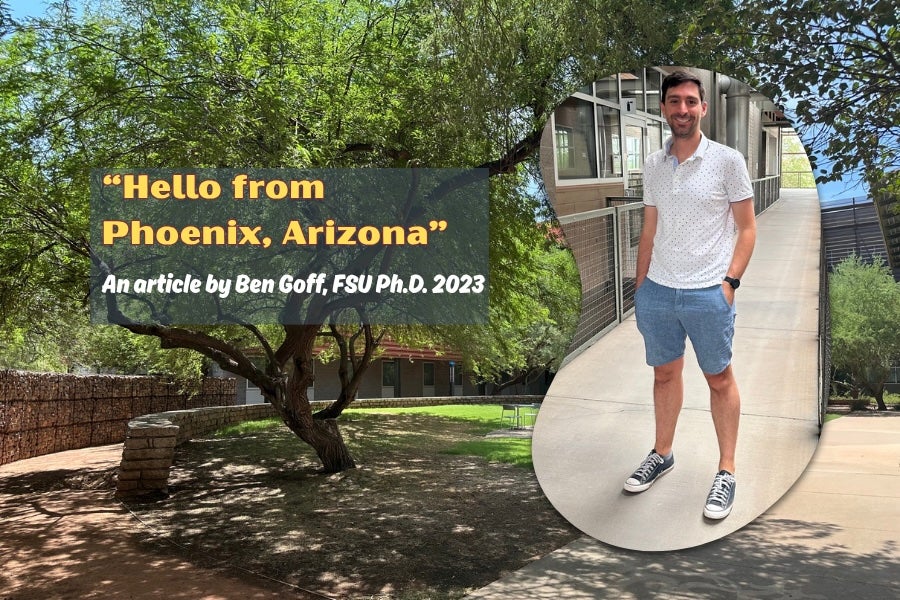
Like many of you, I am currently sprinting madly toward the new semester. While happy to greet the arrival of a fresh academic year, the opportunity to reconnect with Florida State is a welcome respite from the madness.
I accepted an assistant teaching professor post at Arizona State University in 2025 after spending two years as a postdoctoral fellow at the University of Saskatchewan in Canada. These sort of teaching professor positions, a “glow-up” title for the old lecturer, seem to become more prevalent with each hiring cycle. They lack tenure and, hence, security. It would be a lie to say I am not disappointed to miss the tenure track. At the same time, I am grateful to be employed and teaching at a big, state school. Large institutions are better placed to weather volatility in the changing higher-ed landscape, and ASU is truly gigantic. There is, I hope, safety and stability in that.
The transition from a research position to a teaching position has been relatively smooth: a mixture of taxing and stimulating. Preparing and teaching four new classes at the same time is hard, but I survived my first year and anticipate surviving the second.
The interdisciplinary nature of my program, focusing on military science and veterans’ affairs, certainly complicated the transition. History represents a major component of our offerings, but so are international relations, political science, ethics, and more. I’ve had to learn a lot, and fast. For example, in Fall 2025 I developed and taught a new 400-level course on Just War Theory; then in Spring 2026, I did the same for another new 400-level course on Military Theory. The Military and Veteran Studies Program at ASU is young, only three years old at the time of this writing, with many courses still in development. In fact, right now I am working on a class called “Interdisciplinary Approaches to War,” focusing on biology’s, anthropology’s, and psychology’s contributions to our understanding of war as a phenomenon. I see the newness of the program as an opportunity to shape its direction. I would love to set up an analogue wargaming center or institute. This would not only align with the goals of the program but also help students with a much-needed digital detox.
Landing this job came from pure serendipity, a sentiment many academics might share. I needed three lucky breaks. First, having taught military science classes through the U.S. Naval War College allowed me to credibly sell my interdisciplinary skills. I must give a special shoutout to fellow FSU history alumnus Andrew Zwilling for securing me the position. Without this background teaching junior naval officers, I doubt the military-affiliated faculty at ASU would have felt comfortable hiring me.
Second, I had to stumble into a postdoc that gave me two years to grow as a researcher and teacher. All praise and gratitude to Matthew Neufeld who offered me the position. Even though research is not a main component of my job, I still feel the articles published during my post-doc lent scholarly rigor to my application. Additionally, many teaching faculty here still publish, which I hope to do as well.
Furthermore, I taught a course on military-medical history while in Saskatchewan. I used this course, its related teaching observations, and its subsequent student feedback to create a teaching portfolio attached to my ASU job application. I was fortunate that the course aligned well with the nature of the program here. I could legitimately sell teaching experience on subjects such as veterans’ healthcare, PTSD, shellshock, military sexual trauma and more.
Third and finally, Arizona State’s Polytechnic Campus serves as the home base for my position. This STEM campus hosts a lot of engineering and biology majors who need humanities general-education credits and who like to acquire them through courses on engineering history, medical history, and military history. Most of these I can comfortably offer. If I had been applying to a generalized history position, the competition might have been much greater.
All in all, I was lucky to find a post to which my background is very well suited, thanks especially to gracious opportunities presented by Andy and Matthew. Three pieces of advice, I suppose, to students nearing the academic job market: 1) network, 2) read "The Professor Is In" early and often, and 3) take solace in the fact that non-academic work pays better and gives you free time to have a life.
Speaking of which, I should probably get back to the looming semester. -Ben