
History Graduate Student Association Interview with Emily Lu, Vice President
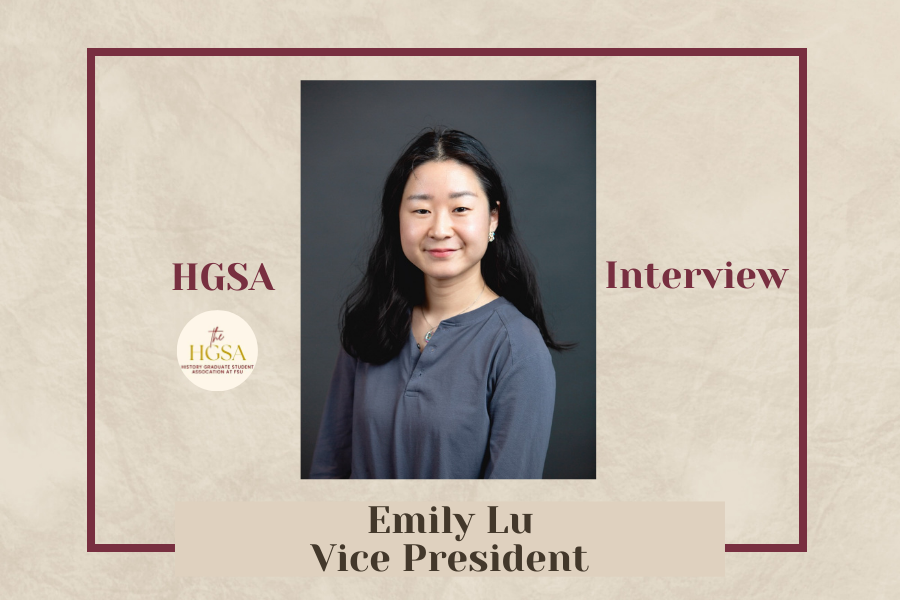
Tell us about your major area of research!
My major area of research is modern East Asia. My dissertation is a study of the intersection between politics and music in imperial Japan and its colonies. My minor fields are ethnomusicology, world history teaching, and early modern Europe. For ethnomusicology, I use music research in my dissertation, so it made sense to cross disciplines. I have always been interested in teaching world history, because it helps us identify wider and more universal patterns in human behavior and thoughts. Before deciding on my current dissertation topic, I wanted to work on Jesuits in early modern East Asia and Latin America, but I lacked the knowledge about the places European Jesuit missionaries came from. That’s why I made early modern Europe one of my minor fields.
What advice would you give to an undergraduate who is thinking about grad school?
I was not a History undergraduate. I have a B.F.A. (Bachelor of Fine Arts) in dramatic writing. I did take history classes—they were eye-opening! They made me think about history beyond just recreational tales that people tell each other without fact-checking or thinking beyond immediacy. I think in grad school I was able to have more say in what I study and research. That made me feel more like an independent scholar and a student with agency.
How did your interest in history start more generally?
I was always interested in old tales my family members told me about the past. My grandparents grew up in northeastern China under Japanese rule, they told me stories of their youth. My father's side of the family migrated from Shandong province to northeastern China, which was the ancestral land of the Manchus, the people who took over ruling China as the Qing dynasty in the mid-17th century. Northeastern China saw an influx of Han Chinese migrants in the mid-1700s due to drought and famine in northern China. My father’s family kept a jiapu, which is a family tree record. My fascination with history grew out of familial tales into curiosity about other families and other cultures.
What do you do as an HGSA officer? What is the role of the HGSA in the department?
As vice president, I assist the president in their duties, but my main responsibility is to see to the planning and execution of our annual graduate conference. Besides giving graduate students a collective representation in the department and college, the HGSA helps graduate students of History connect, build rapport and community. I would highly encourage incoming graduate students to join the HGSA. I regret that I did not actively participate in my first couple of years of my Ph.D.! The HGSA is very helpful in providing community and support to fellow graduate students.