
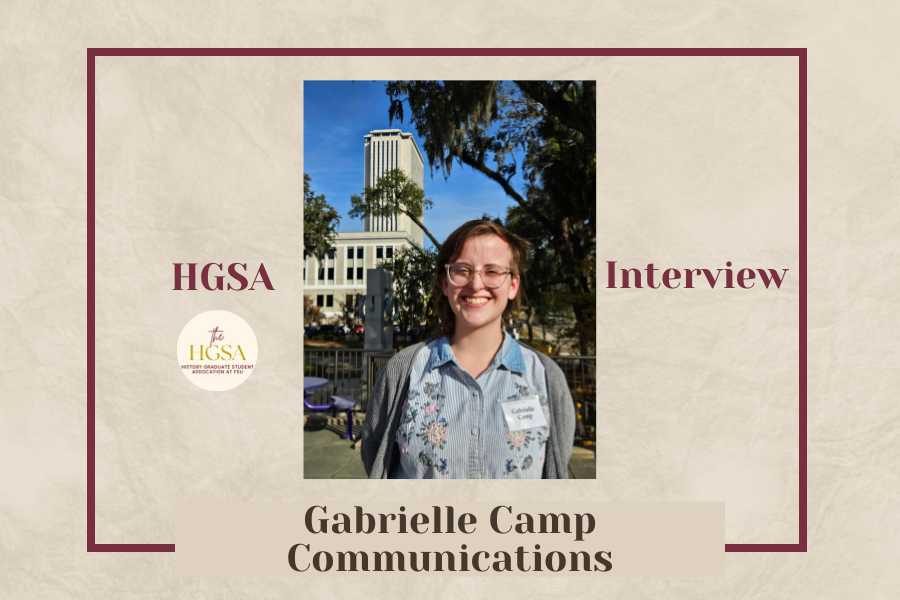
History Graduate Student Association Interview with Gabrielle Camp, Communications Officer
You and your research
I am a second-year M.A. student in History. My major area of research is modern U.S. history. I typically study social movements in the mid-20th century, so I wanted to center my degree in that period. My minor field is Public History. I chose Public History because I knew it would teach me helpful skills for practicing history outside of academia. I also enjoy sharing my love of history with others (especially non-historians) and wanted to learn how to do that.
What is the difference between doing History as an undergrad and as an M.A. student?
The biggest difference between studying History as an undergraduate and as an M.A. student is the reading load. I attended FSU for my undergraduate degree, and even in the upper-level classes, I got maybe a handful of (very short) articles every week across all my courses. As an M.A. student, I read probably twice that amount for just one class.
What advice would you give to an undergraduate who is thinking about grad school?
If you’re thinking about grad school, I recommend reaching out to professors you have worked with before (or professors you are interested in working with in the future!) to talk to them about the program. I was not sure what kind of degree I was interested in, what minor fields I should think about, or what my application should even look like. I met with a couple of professors, who recommended me to a couple of other professors, and they gave me a lot of great feedback about my particular situation. Talking to them helped me to be surer of what I wanted and made my application much stronger.
How did your interest in history start more generally?
I used to think history was incredibly boring. I have never been good at memorizing dates or remembering the names of battles. My interest in history started when I was in eighth grade. I had a wonderful teacher (thank you, Ms. Lively!) who made history come to life. I have always been a big reader, and the way she taught made me feel like I was reading a book. I fell in love with history when I realized that it could be just as much about the story (and the telling of the story) as the hard facts.
What do you do for “fun” history nowadays?
Lately, my version of “fun” history has been reading historical fiction novels. I particularly enjoy horror novels. I like to see how people weave monsters into a supposedly historical narrative, and I like to see what traits make someone/something monstrous at a particular time. Even when writing about the same kind of monster, an author’s personal context and background usually influences what parts of the monster they highlight in their own story. A vampire novel written in 2020 and set in 19th-century Argentina, for example, is going to portray its monsters very differently from a vampire novel written in and about 19th-century England.
What do you do as an HGSA officer?
As the communications officer, I am responsible for keeping up with social media and communications for the HGSA. I create flyers and send out reminders for our events, and I update our website.
How do you see HGSA make a difference to grad student life?
The HGSA is what gives graduate students in our department a voice. We help bridge the gap between faculty and graduate students so that the department continues to serve its students. We also bridge the gap between graduate students by providing social spaces for people in the department to get to know each other professionally and personally.
What would you tell an incoming graduate student about joining the HGSA?
Every graduate student in the History department should join the HGSA! The meetings are a great way to stay informed about what is happening in the department. They also give you a dedicated time to hang out with other graduate students in the program and see what resources and opportunities are available.