
UROP in History: Women Spies during World War II
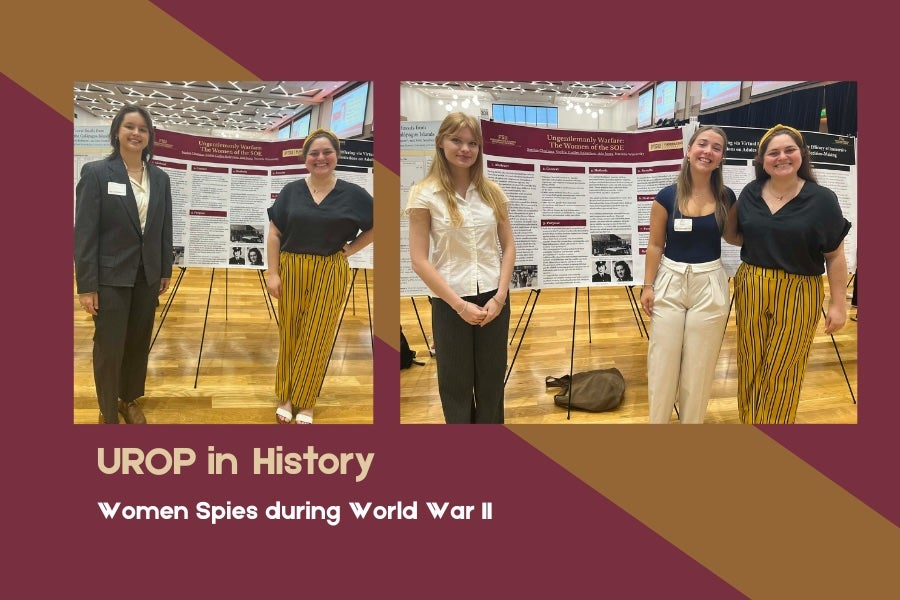
Danielle Wirsansky, Ph.D. candidate in History, was directing an Undergraduate Research Opportunity Program project on women spies during World War II last spring. The aim of the project was to analyze primary source materials from the archives to discern differences in the experience of Special Operation Executive agents based on gender. This was the sixth time that Wirsansky was directing a UROP project on the theme of women spies. She had three students working with her: Sophia, an international affairs and economics double major, Sophie, a humanities and digital media production double major, and Ada, an international affairs major. Both Sophie and Ada are part of the Presidential Scholars Program.
Wirsansky was a UROP student herself as an undergraduate — back in 2013-2014. Although she was a theatre major, she opted to work with Nathan Stoltzfus, Ph.D. on the Rosenstrasse protests in Berlin during WW II. She enjoyed the research aspect so much that she continued to work for the Rosenstrasse project. That led her to do her master’s degree with Stoltzfus; her thesis was on the experience of women spies who worked for the British, connecting their experience to that of British women more generally during WW II. Her Ph.D. dissertation is a gender analysis of the experience of the Special Operations Executive’s agents, both men and women, focusing on each step of their experience from recruitment to execution. Wirsansky was in England for parts of the spring semester doing archival research at the Imperial War Museum and British National Archives in London.
How did you find out about UROP?
Sophia: I found out about it through a school email. I remember looking for research opportunities. I had a class taught by a professor who was an active researcher, and she talked about her research more than any of my other professors had at that point. That made me decide to seek opportunities with research. I came across UROP through the school, and I just applied.
Sophie: Ada and I are in the Presidential Scholars Program here at FSU, and UROP is a requirement for our first year. It's a great opportunity. We are very lucky to be able to do that.
What grabbed you about this particular project?
Sophia: I was drawn to it because I really like World War II history. During the preliminary interviews, Danielle mentioned that she had done a lot of work in the National Archives in London. I had studied abroad there the year before, which made it feel like a good connection. I was interested in reading a lot of primary documents which I think was the main point for me. The project just aligned with my interests.
Sophie: I liked the intersection between gender and history, focusing on women spies and the F section of the Special Operations Executive in France. I'm half French, and I speak the language, so I really was interested in transcribing and translating documents from French and learning more about a part of history I was not really knowledgeable about.
Ada: My interest was definitely in reading primary sources. It is great to have the opportunity to look at primary sources that professors are currently working with. I also had a history class with Danielle last semester in which I first heard about the project, which then made me want to learn more.
How did your UROP project unfold?
Sophia: We started out by reading secondary sources about the SOE and its role in France and in World War II. That helped us to get more acquainted with all the agents that we would be encountering. After that, Danielle assigned each one of us a few papers or boxes of documents, and we went through them and filed them. More recently, our work has become more in-depth. We are listing the kind of information in each document and which agent it pertains to.
Sophie: With regards to the gender aspect of the project, we were told by Danielle to focus on when gendered language is used, any mention of women and how they were portrayed. We had a whole spreadsheet full of agent names, and we tried to establish their backgrounds: religion, nationality, kinship.
Ada: Part of what we did was go through these documents to see what pertained to our individual projects and what pertained to Danielle's dissertation. There were hundreds of boxes with primary sources. Having us read the sources to figure out what they said helped with her research.
Sophia: We all worked on all the agents on the spreadsheet, but each of us had a different focus: I established their kinship ties, Sophie their religions, and Ada their nationalities.
Danielle: My aim was to have the students identify all the handwritten documents that I had found in the archives because I had access to a platform that turned the handwriting into printed text. A lot of the letters and reports that I found were handwritten, in German, French, and English, and translating them from printed text is so much easier than working with handwritten material.
What surprised you the most doing this research?
Sophia: What surprised me was how on first reading about the women spies, I assumed that the women played a lesser role in the world of espionage because of the gendered language that was used. That was not the case. The women did the same things as the men.
I was also struck by how intertwined everybody's stories were. I guess I didn't realize how much they all had to work together. I assumed that since it was covert operations, that people would be doing their own thing and not really work in a unit, but there was a lot more teamwork than I had expected.
Sophie: I agree. When we started reading the secondary sources which described the official accounts, I was surprised how the women were described. Then going back through the original documents and finding the details of what happened was both interesting and shocking. Seeing the sheer amount of work that they did, the number of missions they were on, and the impact they had on the war, was astonishing.
It was interesting to see how much work, how much coordination, how much grit these agents had to have to do their work. Men and women played the same roles; they did the same things.
Ada: What really surprised me was how many of the accounts were written in retrospect. The action occurred at a given time, but the reports were written later, often a few months later. Which means that the accounts report on both the action and its outcome.
What was your favorite part of the whole project?
Sophia: Ada and I got to present our findings together — and that was really fun. Sophie had a different time slot, unfortunately. Presenting our poster board together was probably the most exciting moment for me, because I got to see our work laid out in front of me.
Sophie: My favorite part was reading through the documents. Some were very mundane, dealing with organizational matters. But others were very captivating. Occasionally, I would come across a story that grabbed me. I was given a couple of reports of people’s experiences in concentration camps. Those were tough subjects to deal with. While I was aware of how horrible those were, I had not read personal accounts of them. Relating those stories back to the experiences of the women agents, some of whom lost their lives in concentration camps, is something I’ll remember in the future.
Ada: Having the opportunity to look at primary documents was my favorite part. I am a bit of a history nerd, and I love to piece together history from these individual sources.
How did you handle time management?
Sophia: I tried my best. I struggled more in the first semester because I had not yet learned how to balance everything, but I did get everything done. In the second semester, I found a good method: I reviewed everything I was assigned to do as soon as I was given it. I saw how many pages of reading I had to do, and then I broke them into equal chunks according to the days available. I also had a great schedule that semester, all my classes were at the same times every day. I knew exactly during which breaks I could work on my research and when I had to do other schoolwork.
Sophie: I might have been a little bit less organized than Sophia, but I think I had always known that this was going to be a time commitment. During the first semester when we sorted the documents, that went faster for me, research and schoolwork was easy to balance. Now, I do the same as Sophia, I review what is assigned to me, so I know my workload at the start of the week and what days I will need to work on what project.
Ada: I really must give all credit to Danielle because she has been extremely flexible and easy to work with. She understood that we all have other commitments alongside this. And she expects us to make this a priority, of course, but she understands if we're getting behind, she works with us on that as well.
Sophia: We also have the in-person colloquium in which we made a timeline to help us stay on track. We entered our deadlines, when the draft for the poster was due, for example, and I used that to guide myself.
What advice would you give to an incoming student about UROP?
Sophia: I encourage anybody who is interested in doing research to do it. I have friends who have also done UROP projects in different disciplines, and they all really enjoyed it. I think what matters is to find the right project and to attend as many interviews at the very beginning of the course as you can to see what options are out there. Everybody does research a little bit differently, and some things might be more like to your liking than others.
Ada: I would absolutely encourage anyone who's interested to apply and participate in the program. I think that the biggest piece of advice I have is not to be scared about sending out emails to the project organizers. Just send them out, go to all the interviews, and don't get too concerned with finding a project that connects to your major. Sometimes branching out is more exhilarating and beneficial than sticking close to your comfort zone.
Sophie: My advice is make sure that you have enough time in your schedule to do UROP. And think of trying something beyond your major. It is such an opportunity for students of any discipline to get more interdisciplinary knowledge, which I think is really important to learn in college. Going to college is not just a stepping stone to your future career, it is also a moment to learn more in-depth about things that might not be career related.
Are you planning on continuing with research after UROP?
Sophia: I hope so. I'm not quite sure what other opportunities similar to UROP there are, but if I could, I would definitely look for more opportunities.
Sophie: I'm not entirely sure. Next year I'm starting my major program for film, which is what I'm interested in; my career goal is digital media production. I will need to focus on that. But UROP has shown me that I should not shy away from things I have not done before.
Ada: I'm hoping to do an Honors in the Major project in the future, which means I am definitely going to continue with research.