
#SeniorSeminar Hunter Ballenger & “Cages of Conquest: Zoological Gardens and the Display of Colonial Prowess in Imperial Japan (1868-1945)”
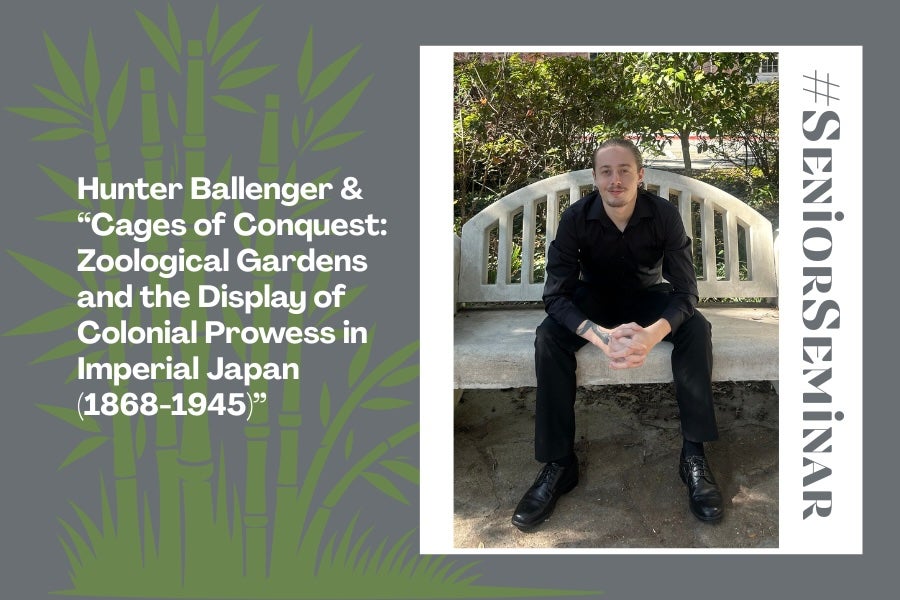
I am a political science major, but I have always been interested in history. I like all sorts of history from medieval to modern. When I looked through the fall course catalogue, I found Dr. Culver’s senior seminar on Japanese imperialism. It was a topic that really fascinated me. As senior seminars are reserved for History majors, I sought and got permission to join the class. It turned out to be my favorite class and professor of the semester.
I had traveled to Japan while I was in middle school. I submitted a paper on Japan in an essay competition and was one of ten students from my county who were selected to go. It was this visit to Japan that kindled my interest in the country, and I have been interested in the culture, language and religion ever since.
What topic did you work on?
I wanted to pick something really niche and decided to work on zoological gardens and exhibition culture in imperial Japan. Specifically, I looked at the procurement of animals, transportation and infrastructure, and how they used animals to project imperial authority and to show that Japan had modernized to a western equivalency. I selected a topic that was overtly apolitical, a leisure space open to the public, and showed how it was strategically used by Japan’s imperial government to normalize their autocratic governance.
I started my project with the Iwakura mission of 1871, in which a group of Japanese statesmen were sent to tour North America and Europe to take notes on the western world, and how this modernity could be implemented in Japan. The findings of this mission started Japan’s process of rapid modernization. Part of this mission and later Japanese explorations of the west included gathering details on what and how to run museums and zoos.
My focus on zoological gardens begins with the late 19th and early 20th centuries. Of course, aristocratic families owned exotic animals well before the 19th century. By contrast, the zoological facilities and exhibitions constructed in imperial Japan and throughout its colonies were unprecedented in scale and served a variety of purposes.
I worked on three zoos established by Japan: one in Tokyo (1882), one in Seoul (1909, Korea) and one in Taipei (1914, Taiwan). By 1910, Korea and Taiwan had both become colonies of Japan. The seminar focused on Imperial Japan, so I felt that it was important to include its colonies. During the Japanese conquest of Korea, much of the Korean imperial palace was destroyed. What was left of the palace was turned into the Seoul zoological garden. This was a very direct way of stamping Japanese imperial authority on Korea. I used the metaphor of "cages of conquest" in my thesis which allowed me to equate zoo animals with Japan’s colonial subjects.
What sources did you use?
Most of the material I used, primary and secondary, I got from Google Scholar. For primary sources, I looked at exhibition catalogues, travel guidebooks and narratives, and scientific studies. Some of the things I found were a catalogue for the 1910 British-Japan exhibition in England, as well as travel reports from people who had visited China, Korea, Japan, and many other regions of Eastern and Southeastern Asia. All my primary sources were either written in English or had been translated into that language.
For secondary sources, I used Ian Miller’s "The Nature of the Beasts." It became my bible for the project. Miller’s book looks specifically at the history of Tokyo Zoo and provides details on the sourcing and transportation of animals. Japanese officials quickly realized that people came to visit the exotic animals.
One of the big problems of my work was that a lot of the records were destroyed during World War II. Especially for the zoo in Taiwan, there is a 40-year gap in the records. That meant that some themes I had hoped to explore, for example, how physical sites for zoos were selected, were not researchable for me at a distance and within the time frame of the senior seminar.
What was it like being the only non-History major in the class?
The senior seminar is a small class, and by design aimed at History majors. There were certain things I had to ask about that were a given to my compatriots. For example, I didn’t have a lot of familiarity with the Chicago style citation method before. I would also view things more from a political science perspective, but since I could frame my own research project that worked out well.
I love writing papers and would always write a paper over doing any other assignment. Still, this was the longest paper I have ever written; it is over 5,000 words. I wrote most of the paper over Thanksgiving break. I made an outline which helped me stay on track with what I wanted to say. I sit down, start writing, and when my brain starts hurting, I take a break.
I am fairly good at multi-tasking as I had to write papers, give presentations and complete a variety of assignments for my other courses, too — and I have a job. I have learned to be independent and was able to stay on top of everything during the semester.
What advice would you give to other students?
You need to put in the work. This class has been the most challenging so far but also the most rewarding. In addition to working on the seminar project, we had to write several smaller papers, a primary source analysis, and a comparative book review. Plus, there was a midterm presentation of our project to the class. If I could go back to the beginning of the semester, I would tell myself to understand the time commitment that the senior seminar required. But I would also tell myself not to worry. That I won’t do just “alright” but I will excel, and thanks to Dr. Culver’s feedback and recommendation I’m looking at getting my paper published.