
Notes from the Workfront: Dr. Ian Varga, Assistant Teaching Professor, University of Missouri-St. Louis
It was a warm, pleasant May afternoon on the Mississippi in 2022. The massive Gateway Arch loomed beside me as I gazed out over America’s great river. It was a moment of both wonder and reflection. Just a couple weeks earlier, I had graduated from Florida State and finally finished my doctoral degree after six years. Now, I was on a short post-graduation trip through America’s heartland, from Chicago down to St. Louis. My stops at places like Abaham Lincoln’s home in Springfield, Illinois, reminded me of the history I was so invested in — but also of the uncertainty of my future. I knew I would return to Tallahassee soon to clean out my apartment and figure out where I was going next. At the time, I had an online job interview lined up for the following week — an interview that felt like it was my last chance at an academic career.
Graduate school taught me many new things. I thoroughly enjoyed my time at Florida State thanks to the help of various faculty members, such as Ronald Doel, my advisor, and Ben Dodds who helped me quite a bit with his observations of my teaching, and the many other graduate students I met. The pandemic in 2020, which disrupted everything in academia for a time, encumbered my research plans for my dissertation and forced me to focus more on teaching. That was fine by me. Teaching was always the part of doing history I liked the most, and I knew I wanted to continue teaching at the university level. My first couple semesters as a teaching assistant at FSU had been a steep learning curve, but the pandemic forced me — and everyone else — to adjust to a tumultuous and changing world. The experience of shifting courses online and having to try new and diverse ways of teaching history turned out to be crucial for my career later.
When I left St. Louis after my trip, little did I know that I would eventually return. I did well in my online job interview and got a one-year position at Wofford College in South Carolina. Although it turned out to be a short stint, it offered me opportunities to teach new types of classes, including seminars, and cemented my deep interest in teaching. I remember students asking at the end of the year to take more courses with me but having to disappoint them. One student told me I would no doubt find a good place to end up.
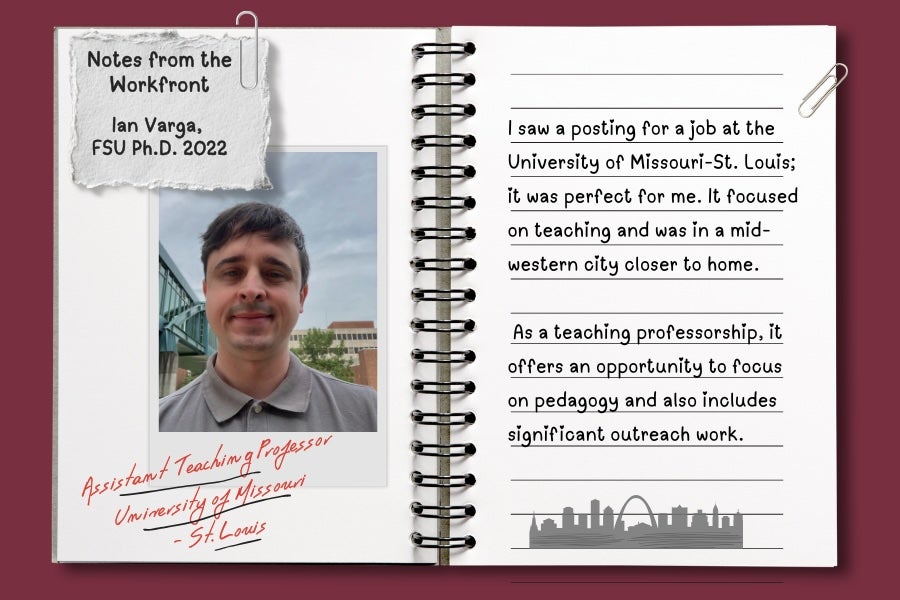
The following year, I had no academic job, but then I saw the posting for a job at the University of Missouri-St. Louis (UMSL); it was perfect for me. It focused on teaching and was in a midwestern city closer to home. The level of both shock and relief when I got the job is tough to describe, and now, a year later, I feel a sense of gratitude. While it’s not the tenure-track position many academics hope for, as a teaching professorship, it offers an opportunity to focus on pedagogy. It also includes significant outreach work. For instance, part of my position includes coordinating the local National History Day contest, a national competition for middle and high school students. Working on the contest has broadened my organizational skills and appreciation for history on the community level. In terms of teaching, my time at UMSL has offered opportunities to experiment in a wide variety of classes, whether lower or upper level, online or offline. We’re encouraged to incorporate new and innovative assignments and tools into our courses, especially digital humanities projects. Because of the department’s tight-knit nature, it’s easy to receive ideas, inspiration, or assistance with anything you might want to try in the classroom.
For those just entering the academic world, especially in such an uncertain time, the future might seem daunting. It is easy to feel a sense of hopelessness or futility as you hunt for a place or position to settle into. However, there are a wide variety of positions out there, both within and outside of academia.